My Experience at the 2026 Fiesta Bowl Flag Football Classic
I was fortunate enough to spend Friday, April 17, through Sunday, April 19, at the inaugural Fiesta Bowl Flag Football Classic in Tempe, Arizona. Overall, it was a fantastic event, and the folks at the Fiesta Sports Foundation were incredible. I can’t thank them enough for providing media credentials to cover the tournament.
This was the first large-scale flag football event I attended. Eight NCAA Division I schools contested the 2026 Fiesta Bowl Flag Football Classic, which had seven club teams and one varsity program. UCF defeated Florida 19-7 in the Championship to win the inaugural event. It's been nearly a week since the event, and it's time to run through some thoughts and feedback on how it went.
Overall Experience
My overall experience at the Fiesta Bowl Flag Football Classic was great. Before this event, I had never received media credentials to any sporting event. I spoke to many people in the flag football and sports world that I wouldn’t have met otherwise. In no particular order, I met flag football enthusiasts like Shawn Fennewald from Women’s College Flag Football and Jocelyn Thomas, as well as coaches Brian Ridge (Florida), Brian Tice (Grand Canyon), Brian Winstead (Benedictine Mesa), Jessie Pap (Arizona State), Katie Sowers (Ottawa/Nebraska), Rene Elizondo (Grand Canyon), and Tyrone Pool (Alabama State). I chatted with multiple flag football club presidents, referees, fellow media types, and countless others at the event.
Having watched many sporting events on television, there are plenty of things happening behind the scenes that you don’t realize as a viewer. I can't imagine how the event staff felt as new issues popped up once the games started. A lot goes into running any event and it provided me with a different perspective. Being the first media-credentialed event for me, I will remember this one fondly. That doesn’t mean it was perfect or without hiccups, but I didn’t encounter any major issues. I recognize that I don’t have an extensive flag football event list to draw against for comparison.
Of course, the main stars of the weekend were the players and the games. There was no shortage of competitiveness, intensity, and passion. They all represented the sport well. As someone who already delves deep into the minutiae of the sport, this tournament highlighted the growth that has already occurred... and gives a small glimpse of what the next several years have in store.
Logistics and Venue
The 2026 Fiesta Bowl Flag Football Classic was held in Tempe, Arizona, on the campus of Arizona State University. The games took place at Dorsey Fields, which are typically used for intramurals and recreational athletics. There were two fields set up next to each other for games to be played simultaneously. I had no issues with the setup of the fields or the venue. After all, this first event didn't warrant a huge stadium like the Fiesta Bowl at State Farm Stadium. Even if the men's football stadium was available, I don't think it would have been necessary. The championship game was held at ASU's soccer stadium, which was a short walk from Dorsey Fields.
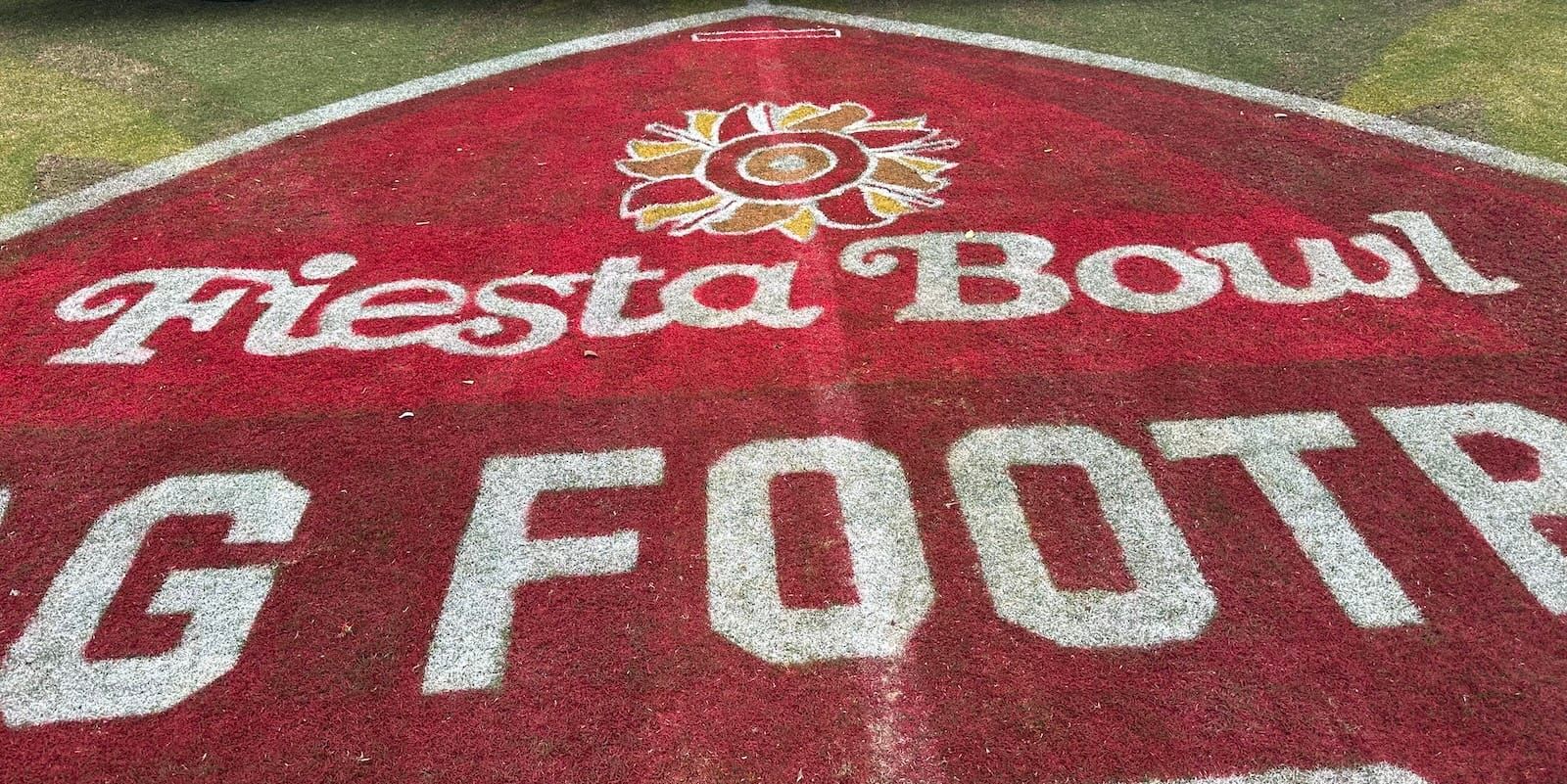
The best part of the event was that the fields were treated like proper flag football fields. The dimensions and markings were specific to flag football. Since it was a Fiesta Sports Foundation event, a Fiesta Bowl logo specific to the event was painted on all three fields used throughout the weekend. Having the proper markings and dedicated space gave the impression that the Fiesta Bowl is taking the sport seriously. That belief was only strengthened when speaking with the Fiesta Sports Foundation during and after the tournament.
Format and Scheduling
The 2026 event was an 8-team tournament, with the teams split into groups of 4. Each team played a round-robin (3 games) on Friday, followed by the bracket play on Saturday. Games started at 9 AM local time on Friday and went as late as 8 PM. No team had the 9 AM start and 8 PM finish, but UCF did have a game finish at 8 PM, followed by an 8:30 AM Saturday start.
I personally didn’t have an issue with the format, but I think the teams were a bit gassed by the third game on Friday. It got above 85-90 degrees both days, and the sun was intense. Did it have an impact on how the bracket played out? No. Florida and UCF were the top two teams all tournament. There was a tight turnaround on Sunday with the semifinals finishing around 2 PM and the championship taking place at 3 PM. This is one bit of feedback I provided to the organizers for next year.
I’ll acknowledge that ESPNU broadcasting the game is the biggest factor. To grow flag football, you make it work with your broadcast partner. I don’t think the short turnaround to the championship game hurt the tournament overall. I think it represents an opportunity for the Fiesta Sports Foundation and ESPN, especially with plenty of time until the next Fiesta Bowl Flag Football Classic.
TV Broadcast
Since I was at the stadium, I didn’t see the ESPNU broadcast of the semifinals or championship game. I won’t comment on that aspect, but I will offer one ideal outcome: have ESPN broadcast the game as part of its Women’s Sports Sundays. In early 2026, ESPN announced a weekly primetime programming block that will feature WNBA and NWSL games. The initial launch of the Women’s Sports Sundays is set to replace ESPN’s Sunday Night Baseball later this summer. In an ideal scenario, ESPN would have a special edition with the NWSL serving as a lead-in to the Fiesta Bowl Women’s Flag Football Classic Championship game.
This scenario assumes that the dates for the Flag Football Classic are similar to the 2026 event. Moving the dates to earlier in April would conflict with the women’s basketball tournament. Pushing the tournament to mid-May would run up against the women’s NCAA softball tournament. I think the mid-April dates are ideal for next year's event. Another factor is whether the tournament format remains the same…
Expanded Bracket?
The prevailing belief amongst the people I spoke to at the tournament was that next year’s event seems likely to expand. Logically, that means 12 or 16 teams, which present pros and cons. Any expansion would require three or four fields, compared to the two that were used in this first event.
For a 12-team tournament, the most likely format would be four groups of three teams. This would also mean that teams play two group games instead of three. The top team in each group would receive a bye to the quarterfinal round, while the remaining 8 would play in the first round. The 12-team tournament could keep its two-day game format. The group and first round games could be played on Saturday, while the quarterfinals, semifinals, and championship would be held on Sunday. Media day would remain on Friday, missed class time is kept to a minimum, and there are no additional days of expenses.
For a 16-team tournament, the format would likely be doubled, with four groups of four teams. All 16 teams would compete in the first round of the bracket. The 16-team tournament would almost certainly require a third day of games. Under the current schedule, the three group games would be on Saturday, followed by as many as four elimination games on Sunday. The timing of those games would range from early morning to the evening. Adding an extra day would require another day of missed classes and extra costs.
I personally like allowing the teams to have three group games, although preferably not on the same day. Adding one day to the event would alleviate some of the scheduling congestion, especially since there will likely be more fields. Games spread out over three days are preferable, but it has to work for the coaches, players, teams, volunteers, Fiesta Sports Foundation, and ESPN. I'm sure other formats will be discussed, and possibly implemented for 2027, which makes sense since flag football isn't an NCAA Championship Sport... yet.
Wrap Up
I thought the inaugural Fiesta Bowl Flag Football Classic was excellent. There are some things I'd like to see, such as an extra day (if possible) and more time between the semifinals and the championship game. I thought the 8-team setup worked quite well, and it seems like that 2027 edition will have more teams. Having more teams and more flag football can work, especially if there's an extra day on the schedule. The folks at the Fiesta Sports Foundation know how to run a premier event, and with a flag football event under their belt, I'm excited to see how the 2027 Fiesta Bowl Flag Football Classic will turn out.